
Engineering for curious teens
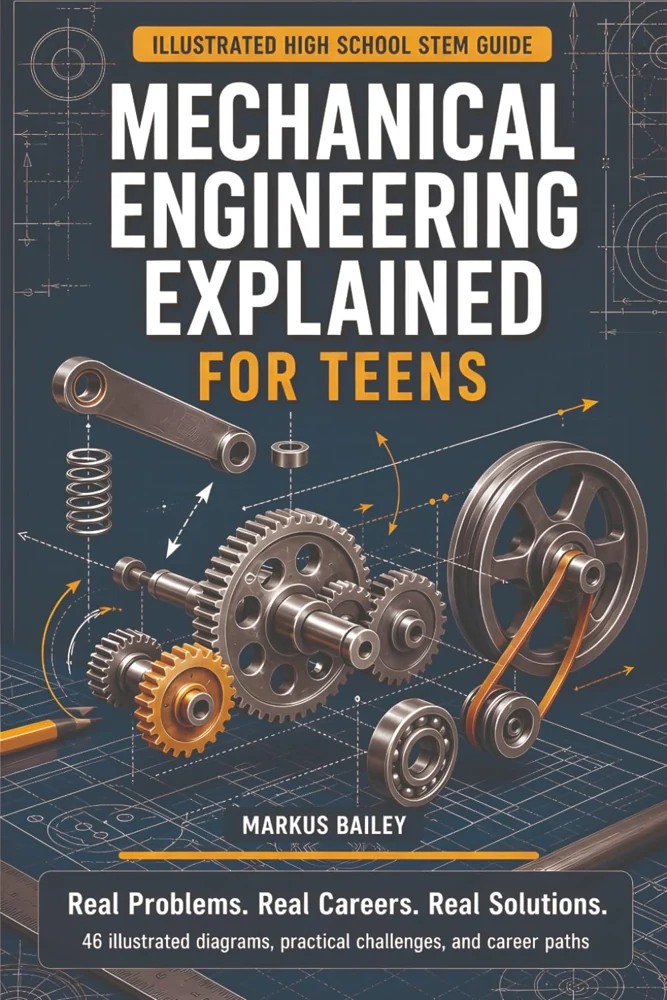
Mechanical Engineering Explained for Teens
Real Problems. Real Careers. Real Solutions.
An illustrated introduction to mechanical engineering through everyday objects, evidence, design choices, and career exploration.
View this edition on Amazon (opens in a new tab) ↗(affiliate link)Current price and format availability are shown on Amazon.
Book at a glance
- Target reader
- For teens curious about forces, machines, and practical problem-solving, and families exploring engineering interests. Connect mechanical ideas with real problems and possible career paths.
- Before you start
- No previous physics study is needed to begin. Start by observing familiar objects and asking why their parts are designed that way.
- Ways to use it
- Independent reading, parent or mentor conversations, engineering interest exploration, and a starting point for an observation notebook.
- Edition described
- Illustrated second-edition paperback: 134 pages and 46 figures. Other formats are shown on Amazon.
What you will explore
- Connect forces, motion, and energy to familiar machines.
- Compare material choices and test ideas against evidence.
- Document design decisions and explore mechanical engineering careers.
Who this book is for
For teens curious about forces, machines, and practical problem-solving, and families exploring engineering interests. Connect mechanical ideas with real problems and possible career paths.
Explore the ideas
- Forces and machines
- Practical problems and solutions
- Mechanical engineering career paths
Inside the book
A hinge, zipper, wheel, or phone stand can be a starting point. Notice which parts move, where a force acts, and what behavior you can observe. Record your explanation and the evidence you would need to check it. The book follows these observations into measurement, forces, energy, material choices, reliability, and a complete mini project.
View all 23 chapter titles
- Chapter 1: How to Use This Book
- Chapter 2: How Engineering Actually Works
- Chapter 3: Starting Quiz, What You Already Know
- Chapter 4: A World of Systems: Why Nothing Works Alone
- Chapter 5: Logical Thinking Without Coding
- Chapter 6: From Instructions to Behavior: How Machines Follow Rules
- Chapter 7: Data Is the Fuel, Assumptions Are the Smoke
- Chapter 8: Measurement Before Conclusion
- Chapter 9: Machines Everyone Uses
- Chapter 10: Force, Motion, and Why Things Move
- Chapter 11: Energy and Power in Daily Life
- Chapter 12: Materials and Manufacturing Basics
- Chapter 13: How Engineers Solve Problems
- Chapter 14: Design Challenge, Smart Mechanical System
- Chapter 15: Project Gallery, Mechanical Systems That Matter
- Chapter 16: Portfolio Evidence and Public Trust
- Chapter 17: Maintenance, Care, and Long Term Reliability
- Chapter 18: Adaptable Designs and Controlled Change
- Chapter 19: Failure Modes, Recovery, and Redundancy
- Chapter 20: Handoff Documentation and Project Stewardship
- Chapter 21: Responsibility, User Boundaries, and Engineering Ethics
- Chapter 22: Fair Iteration, Metrics, and a Capstone Improvement Plan
- Chapter 23: A Complete Mini Project, Start to Finish
Reference and next-step sections
- Project Pages and a Troubleshooting Log
- A Working Glossary
- A 30 Day Resource Map for Going Further
- A Mechanical Engineering Career Roadmap
- Teen Portfolio Builder
- Questions to Ask an Engineer
- If You Like X, Explore Y
- Observation Challenges, No Tools Required
To read any available sample, open the book’s Amazon listing and choose Read Sample.
View the book and available sample on Amazon ↗(affiliate link)Keep exploring
Teen Engineering Challenge Lab
Ten safe build-test-improve challenges plus printable design and test pages for curious teens.
A separate free companion for ages 12–17, with 16 pages.
Explore the free companion →Questions before choosing
Which mechanical edition does this page describe?
This page describes the illustrated second-edition paperback, Amazon ASIN B0HD28B44S, with 134 pages and 46 figures. It is distinct from the earlier paperback edition.
Do I need to buy equipment before reading?
You can begin with observation of everyday objects and a notebook. Follow each activity’s guidance; work involving tools, disassembly, power, heat, or moving machinery requires qualified adult supervision.
Page & Purpose / Markus Bailey
Keep reading with us
Join the Page & Purpose / Markus Bailey reader list for occasional useful resources, new books, and offers. Unsubscribe at any time.
Choose engineering and science for practical learning ideas and companion resources.
Joining is optional. Downloads, purchases, and reviews stay independent.