
Engineering for curious teens
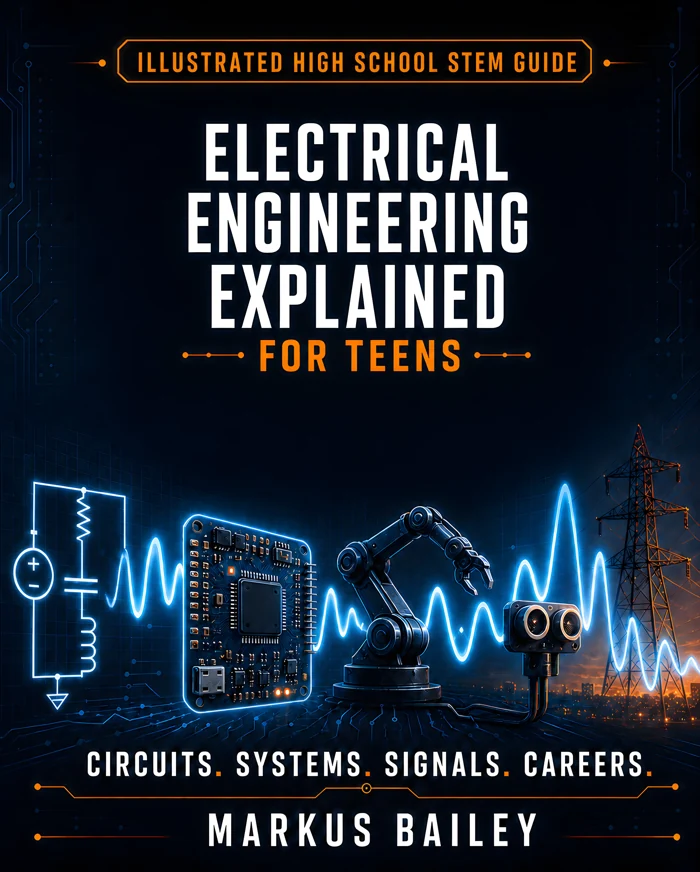
Electrical Engineering Explained for Teens
A Conceptual Guide to Circuits, Systems, Design, and Career Questions
A conceptual introduction to how electrical engineers reason about circuits, signals, systems, and design decisions.
View this edition on Amazon (opens in a new tab) ↗(affiliate link)Current price and format availability are shown on Amazon.
Book at a glance
- Target reader
- For teens curious about circuits and electrical systems, and families exploring what engineering involves. Start with the concepts, then consider how engineers make design decisions and ask career questions.
- Before you start
- Read for concepts and questions; Chapter 8 introduces the math and physics tools involved. Activities focus on paper reasoning and simulation.
- Ways to use it
- Independent reading, family discussions about engineering interests, and a classroom or homeschool reference alongside other learning materials.
- Edition described
- Paperback interior: 108 pages. Other format availability is shown on Amazon.
What you will explore
- Explain the roles of charge, voltage, current, resistance, and power.
- Follow signals, components, and feedback through a system.
- Compare career interests and plan ways to explore the subject.
Who this book is for
For teens curious about circuits and electrical systems, and families exploring what engineering involves. Start with the concepts, then consider how engineers make design decisions and ask career questions.
Explore the ideas
- Circuits and electrical systems
- Engineering design decisions
- Questions about engineering careers
Inside the book
Start with a device you already know. Identify a goal, an input, and the result a person notices. Then ask what information or energy moves through the system, what conditions matter, and what evidence would help check your explanation. The book develops this kind of reasoning through circuit concepts, signals, debugging, and career questions.
View all 14 chapter titles
- Chapter 1: The World Is Running on Electrical Engineering
- Chapter 2: Charge, Voltage, Current, Resistance, and Power
- Chapter 3: How a Circuit Becomes a System
- Chapter 4: Components: The Small Parts with Big Jobs
- Chapter 5: Signals: How Information Rides on Electricity
- Chapter 6: Power: From Battery to Grid to Device
- Chapter 7: Embedded Systems, Robotics, and Control
- Chapter 8: Math and Physics: The Tools, Not the Gatekeepers
- Chapter 9: Debugging Is the Job
- Chapter 10: Designing for Real People
- Chapter 11: A Week in Electrical Engineering
- Chapter 12: Is Electrical Engineering Your Next Step?
- Chapter 13: Six Low-Risk Ways to Explore Further
- Chapter 14: Build Electrical Engineering Simulations and Games with AI
Reference and next-step sections
- Glossary
- The Engineer’s Notebook Template
- Six Ways to Explore (A Pull-Out Checklist)
- Source Notes and Bibliography
To read any available sample, open the book’s Amazon listing and choose Read Sample.
View the book and available sample on Amazon ↗(affiliate link)Keep exploring
Virtual Electrical Engineering Lab & Portfolio Kit
Guided virtual labs, engineering evidence pages, AI verification tools, and portfolio-ready reflection prompts for teens.
A separate free companion for ages 12–17, with 59 pages.
Explore the free companion →Questions before choosing
Does this book include electrical build projects?
The book is conceptual. Its activities use paper reasoning, computer simulation, and observation of closed devices. It does not provide instructions to wire, open, repair, or modify electrical equipment.
What is in the free companion?
The separate Virtual Electrical Engineering Lab & Portfolio Kit includes seven virtual missions, career reflections, a portfolio summary, and a 30-day plan. Its 59 pages are available without signup or a book purchase.
Page & Purpose / Markus Bailey
Keep reading with us
Join the Page & Purpose / Markus Bailey reader list for occasional useful resources, new books, and offers. Unsubscribe at any time.
Choose engineering and science for practical learning ideas and companion resources.
Joining is optional. Downloads, purchases, and reviews stay independent.